Embedding
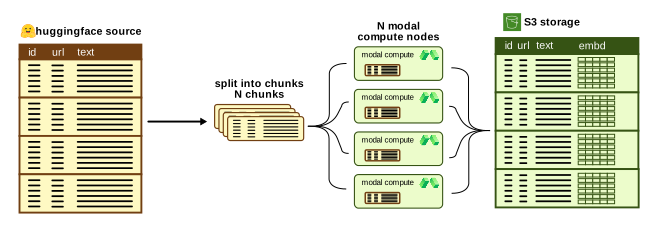
nova embed streams rows from a dataset, runs one or more embedding models
over them, and writes the results as parquet. The output is what
nova load and nova bf read.
Config
A config has four sections: where rows come from (source), which models run
(embedders), how the run is batched (pipeline), and where parquet goes
(storage). More examples live in configs/embedder/.
source:
  type: huggingface
  dataset_name: mteb/tweet_sentiment_extraction
  split: train

embedders:
  - name: dense                   # output column: dense_embedding
    kind: dense                   # dense | sparse | multivector
    type: sentence_transformer    # backend, see the table below
    model: sentence-transformers/all-MiniLM-L6-v2
    input_column: text
    modality: text                # text | image | multimodal (required)
    batch_size: 64

  - name: bm25                    # output column: bm25_embedding
    kind: sparse
    type: fastembed
    model: Qdrant/bm25
    input_column: text
    modality: text

pipeline:
  chunk_size: 10000               # rows per batch
  flush_threshold: 100000         # rows per output parquet file

storage:
  type: object_store
  path: s3://my-bucket/tweets/minilm
Each entry in embedders: writes one column, named {name}_embedding unless
you set output_column. Keys the pipeline doesn't know (batch_size, dtype,
device, revision, ...) are passed to the backend. ${VAR} and
${VAR:-default} are expanded from the environment.
Embedders
type |
kind |
Inputs | Notes |
|---|---|---|---|
sentence_transformer |
dense, sparse | text, image (dense only) | Any sentence-transformers model. Sparse uses SparseEncoder (SPLADE-family, BM42). CLIP-family models take images. |
fastembed |
dense, sparse, multivector | text | fastembed's ONNX models: e.g. BAAI/bge-small-en-v1.5 (dense), Qdrant/bm25 (sparse), colbert-ir/colbertv2.0 (multivector). Runs well on CPU. |
openai |
dense | text | OpenAI API, or any OpenAI-compatible server via base_url (api_key: none for local servers). |
bge_m3 |
dense, sparse, multivector | text | BAAI/bge-m3. |
vllm |
dense | text, image, multimodal | vLLM pooling runner. The only backend that takes modality: multimodal. |
Entries on the same model and input column are fused into one forward pass
when the backend supports it (e.g. bge_m3 dense, sparse, and multivector
together). This happens automatically.
Sources
type |
Reads | Sharded by |
|---|---|---|
huggingface |
Parquet datasets on the Hugging Face Hub | Row range |
huggingface_jsonl |
JSON Lines datasets on the Hub (e.g. MedRAG/pubmed) |
Whole files |
Both take dataset_name and split, plus:
render_columnsbuilds a new column from others, e.g.combined: "{title}: {abstract}". Use it as aninput_column.exclude_columnsdrops columns before anything is read or embedded.
To split long text before embedding, add a chunking: block with
strategy: fixed_char (chunk_chars, overlap). Splitting requires every
entry to read the same text column.
Pipeline options
| Key | Default | Meaning |
|---|---|---|
chunk_size |
10000 |
Rows embedded per batch. |
flush_threshold |
100000 |
Rows buffered before a parquet file is written. |
row_group_size |
pyarrow default | Parquet row-group size. Smaller groups let readers fetch and decode a file in parallel. |
on_empty_input |
skip |
Empty input: skip the row, write a null embedding, or error. |
drop_columns |
[] |
Source columns to embed but leave out of the output (e.g. raw image bytes). |
content_addressed_files |
false |
Name each file by a hash of its contents. Makes re-runs idempotent. |
shard_output_buckets |
none | Spread files across N subdirectories. |
include_source_provenance |
false |
Add source_file_name and source_row_number columns. |
Storage
type |
Writes to | Key |
|---|---|---|
object_store (alias s3) |
S3 (s3://), GCS (gs://), Azure (az://), or any S3-compatible store (set endpoint) |
path |
hf |
A Hugging Face Storage Bucket | bucket_id |
local |
Local disk | output_dir |
Credentials come from each provider's usual environment variables or config
files. Extra provider options go under config: and are passed to
obstore. Downstream
tools read S3 reliably; check that yours can read GCS or Azure before a big run.
Output
Every source column is kept, plus one column per embedder entry:
kind |
Arrow type |
|---|---|
dense |
list<float32> |
sparse |
struct{indices: list<uint32>, values: list<float32>} |
multivector |
list<list<float32>> |
There is no id column. nova load derives point ids from each row's file path
and row number, so re-reading the same files always gives the same ids.
Each run also writes _manifest.json (rank<NN>__manifest.json per rank in a
fleet run) next to the parquet. It records the models, their resolved
revisions and dtypes, library versions, the git commit, the rank's row range,
and whether the rank finished (complete).
Running
nova embed <config>                          # run locally
nova embed <config> --dry-run                # print the plan, embed nothing
nova embed <config> --num-jobs 8 --job-rank 0  # one shard of a fleet run
--job-rank defaults to $SKYPILOT_JOB_RANK. See
Distributed for launching a fleet.
To estimate throughput and cost before renting GPUs, run nova embed predict.
It samples the dataset, tokenizes it with each model's tokenizer, and prices
the run for a GPU type. It doesn't need a GPU. Treat the numbers as a way to
compare options (GPU types, batch sizes, cutoffs): in validation runs the
median prediction was off by about 1.6x.