Brute Force
nova bf computes exact k-nearest-neighbor results for a query set. These results provide ground truth for evaluating approximate vector search systems using metrics such as recall@k.
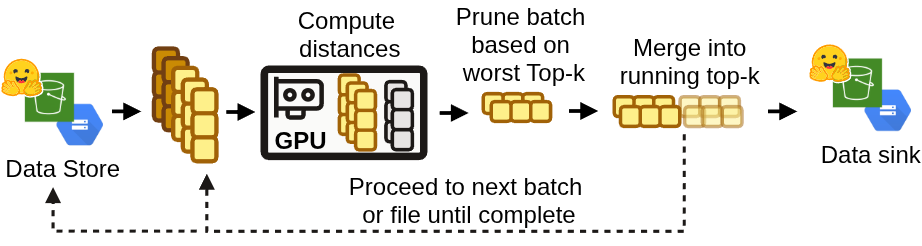
For distributed runs, workers independently scan corpus shards and produce partial top-K results, which are merged into a global top-K.
Config
corpus:
  path: s3://my-bucket/dataset/model
  dense_column: dense_embedding

queries:
  path: s3://my-bucket/dataset/model/queries.parquet
  dense_column: dense_embedding
  payload_fields: [text]

output:
  path: s3://my-bucket/dataset/model/eval

params:
  io_workers: 16

searches:
  - name: dense_all
    vector_type: dense
    metric: cosine
    k: 1000
Each entry in searches defines an independent search. Multiple searches in the same run share corpus reads when possible.
Environment variables support ${VAR} and ${VAR:-default} expansion.
Vector Types
dense:list<float32>using cosine, dot product, or Euclidean distance.sparse: sparse index/value vectors using dot product or cosine.multivector: token-level vectors scored using ColBERT-style MaxSim.
Filters
A search's filter restricts which corpus rows are eligible. Filters follow the Qdrant-style must (AND), should (OR), and must_not structure.
filter:
  must:
    - field: language
      match: eng
  should:
    - field: source
      match: [wiki, news]
  must_not:
    - field: cost
      range: {gte: 10}
Each condition uses one filter type. Conditions cannot be nested, and null values never match.
match
Matches exact values; a list matches any value.
range
Supports any combination of gt, gte, lt, and lte.
For dates, list fields in corpus.date_fields. Bounds use RFC 3339 unless another format is specified.
corpus:
  date_fields: {published_at: rfc3339, crawl_day: "%Y%m%d", ingested_at: epoch_s}

filter:
  must:
    - field: published_at
      range: {gte: "2013-01-01T00:00:00Z"}
match_text
Matches rows containing every word in the phrase, in any order. Text is lowercased and tokenized like Qdrant's word tokenizer with lowercase: true; stemming and stopwords are not applied.
Per-query filters
match_from_query, range_from_query, and match_text_from_query take values from columns in the queries file, allowing each query to use its own restrictions.
filter:
  must:
    - field: tenant_id
      match_from_query: tenant_id
    - field: cost
      range_from_query: {lt: max_budget}
    - field: title
      match_text_from_query: search_phrase
Static and per-query conditions can be mixed:
A range_from_query condition cannot also contain a literal bound; use separate conditions instead. Per-query date columns must be listed in queries.date_fields.
match_from_query and range_from_query run on the GPU. match_text_from_query runs on the CPU and builds a queries × rows mask per file, so it can be expensive for large query sets.
Running
Single GPU:
Distributed:
nova dist bf can provision and execute distributed workers automatically.
--max-files N is useful for performance testing, but its output is not valid full-corpus ground truth.
Output
Each search produces:
Important columns are:
| Column | Description |
|---|---|
query_id |
Query identifier |
hit_ids |
Top-K corpus IDs, best first |
hit_scores |
Corresponding scores |
A manifest is also written with configuration, hardware, code version, and timing information.
IDs and Ties
hit_ids must match the point IDs used when loading the corpus into the vector database.
By default, Nova derives deterministic IDs from file paths and row numbers. An existing ID column can instead be specified with corpus.id_column.
Exact-score ties are resolved deterministically using either corpus order (ordinal, default) or corpus.id_column.
Performance
Brute-force execution overlaps corpus I/O, CPU decoding, and GPU scoring. For many workloads, reading and decoding are the primary bottlenecks.
Useful tuning options include:
io_thread_count: S3 fetch concurrency.cpu_thread_count: decoding and filtering threads.io_workers: concurrently processed files.dense_batch_size/sparse_batch_size: bound GPU memory usage.two_pass: safely skips candidates that cannot enter the top-K.allow_tf32: enables faster matmuls but sacrifices exact float32 scoring.
For large AWS runs, prefer high-vCPU GPU instances in the same region as the dataset.