Load
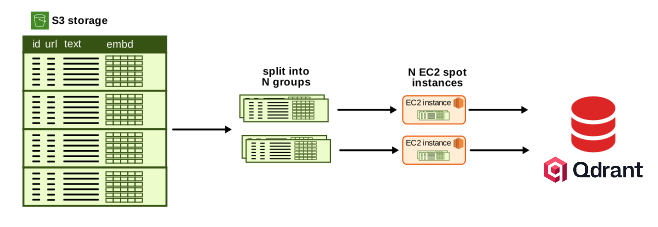
nova load reads pre-embedded Parquet files from S3 or local disk and loads them into a vector store. Qdrant is built in; Elasticsearch, OpenSearch, and Milvus are optional.
Config
datasource:
  type: s3
  path: s3://my-bucket/dataset/model
  id_expression: "vf_point_id(filename, file_row_number)"
  payload_fields:
    text: text
    source: source

vectors:
  dense:
    type: dense
    column: dense_embedding
    distance: cosine
  sparse:
    type: sparse
    column: sparse_embedding

vectorstore:
  type: qdrant
  url: ${QDRANT_URL}
  api_key: ${QDRANT_API_KEY}
  collection_name: my-collection

loader:
  batch_size: 256
  concurrency: 8
Environment variables support ${VAR} and ${VAR:-default} expansion.
Running
Single machine:
Distributed:
nova load prepare my.yaml
nova load load my.yaml --num-jobs 32 --job-rank $RANK
nova load finalize my.yaml
Workers independently process subsets of the input files. nova dist load can provision and launch the workers automatically.
Other commands:
nova load inspect my.yaml   # dry run
nova load reindex my.yaml   # rebuild with new index settings
nova load delete my.yaml    # delete the collection
Resuming
Use --continue to resume an interrupted load:
Resuming requires the same files, worker count, and a deterministic id_expression.
Datasources
S3:
Local:
file_list may be used to restrict either source to specific files.
Point IDs
id_expression is a DuckDB expression evaluated for each row. The default uuid() generates new IDs on every load.
For stable IDs compatible with nova bf ground truth:
An existing ID column or other DuckDB expression may also be used.
Payload
payload_fields maps stored payload names to DuckDB expressions:
String, integer, float, and boolean values are supported directly. Cast other types when needed.
Vectors
Each entry under vectors defines a named vector.
| Key | Description |
|---|---|
type |
dense, sparse, or multivector |
column |
Parquet column |
distance |
cosine, dot, euclid, or manhattan |
size |
Vector dimension; inferred if omitted |
datatype |
float32, float16, or uint8 |
on_disk |
Store vectors on disk |
comparator |
Multivector comparator; default max_sim |
modifier |
Sparse modifier: none or idf |
Qdrant Settings
Connection settings are configured under vectorstore:
Collection and index settings go under vectorstore.params:
vectorstore:
  params:
    shard_number: 6
    replication_factor: 2
    on_disk_payload: true

    hnsw:
      m: 16
      ef_construct: 100
      on_disk: true

    quantization:
      type: scalar
      quantile: 0.99

    optimizers:
      indexing_threshold: 20000
Unset values use Qdrant defaults.
Supported quantization types are scalar, product, binary, turbo, and none.
Reindexing
nova load reindex updates HNSW, quantization, and optimizer settings on an existing collection without reloading the data.
Custom Sharding
custom_sharding routes points using a DuckDB expression:
Shard keys must be strings or non-negative integers, and the expression should be deterministic.
Other Backends
Optional backends support dense vectors:
opensearchelasticmilvus
Build support with:
Backend-specific connection and index settings are configured under vectorstore.
Tuning and Failures
Common loader settings:
| Key | Default | Description |
|---|---|---|
batch_size |
256 |
Points per upsert |
concurrency |
CPUs - 1 | Upserts in flight |
file_look_ahead |
2 |
Files prepared ahead of upload |
file_retries |
5 |
Retries before a file is skipped |
upsert_retries |
5 |
Retries before the run aborts |
max_points_per_sec |
unlimited | Per-worker rate limit |
If the vector store is overloaded, increase vectorstore.timeout_s, then reduce concurrency or set max_points_per_sec.
Loader limits are per worker, so fleet-wide throughput scales with the number of workers.